
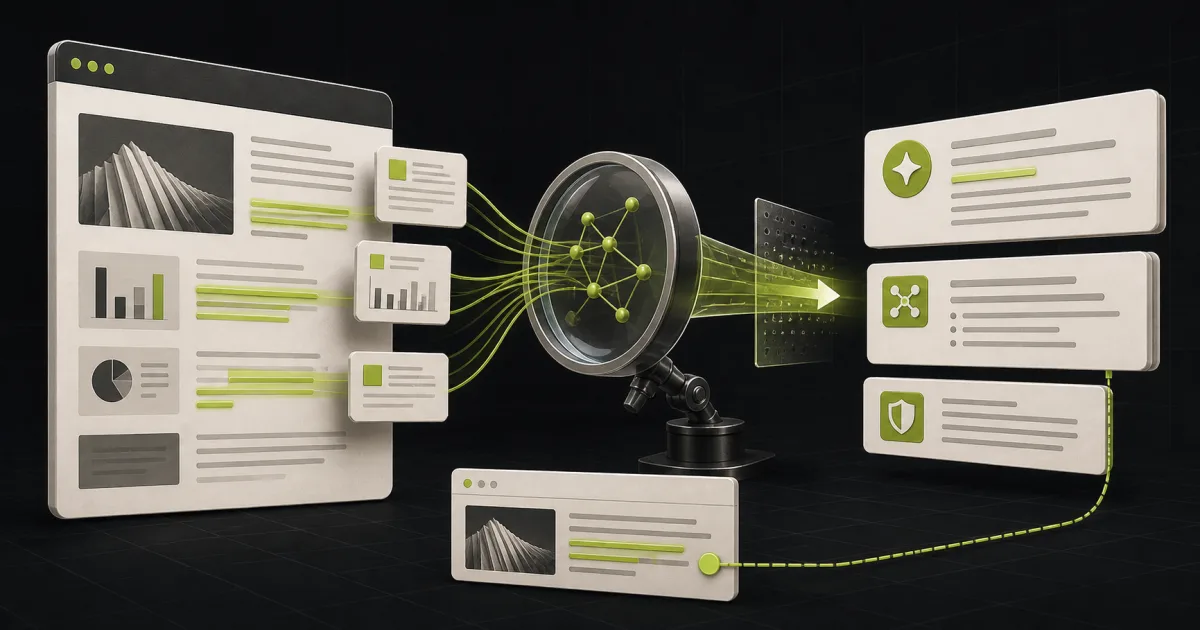
How AI assistants choose which sources to cite
Before you can get cited by ChatGPT, Perplexity, or any other AI assistant, it helps to know what is actually happening when one of them answers a question with sources attached. The assistant is not browsing the web the way a person does. It runs a retrieval step: the question is turned into one or more searches against an index, a shortlist of candidate pages comes back, the system reads the most promising passages, and the answer is composed with citations pointing at the passages it leaned on.
That pipeline has three gates, and your site has to pass all of them. First, the crawler gate: if the platform's bots cannot fetch your pages, you do not exist to the system. Second, the retrieval gate: your page has to surface in the shortlist for the question being asked, which is why ordinary search visibility still underpins AI visibility, a point Google makes explicitly in its AI features guidance. Third, the quoting gate: from the shortlist, the system favours passages that state a clear, self-contained answer it can lift without reconstruction. We covered the visibility fundamentals in is your website visible to AI search; this article is about the practical steps beyond them.
One caveat before the steps, stated plainly because plenty of agencies will not: nobody can guarantee a citation. These systems change frequently, their retrieval is not public, and the same question can cite different sources on different days. What follows raises your odds. Nothing sells certainty here except people selling certainty.
Step 1: Allow the AI crawlers in robots.txt
Each platform fetches the web with named bots, and each respects robots.txt directives aimed at those names. Plenty of sites blocked everything with "AI" in the name during 2023 and 2024, sometimes via a security plugin or CDN setting the owner never saw, and are now invisible to the assistants their customers use. Checking takes two minutes: open yourdomain.co.uk/robots.txt and look for these user agents.
| User agent | Operator | What it does |
|---|---|---|
| OAI-SearchBot | OpenAI | Builds the search index behind ChatGPT search. Blocking it removes you from ChatGPT's cited results. |
| ChatGPT-User | OpenAI | Fetches pages on demand when a ChatGPT user's request needs your live page. |
| GPTBot | OpenAI | Gathers content for model training. Separate from search: you can block this and still allow the two above. |
| PerplexityBot | Perplexity | Indexes pages for Perplexity's answer engine, which cites sources by design. |
| Perplexity-User | Perplexity | Fetches a page when a Perplexity user's question calls for it directly. |
| ClaudeBot | Anthropic | Anthropic's crawler. Blocking it limits how Claude products can use your content. |
| Google-Extended | A training control for Gemini models. Note: blocking it does not remove you from AI Overviews, which follow normal search indexing. |
The detail most people miss is the split between search bots and training bots. OpenAI documents its bots separately at platform.openai.com/docs/bots, and Perplexity documents its crawlers at docs.perplexity.ai. You can hold a principled position on training data by blocking GPTBot while still allowing OAI-SearchBot and ChatGPT-User, keeping yourself citable. For most UK service businesses, though, the pragmatic position is to allow all of them: the content on a plumber's or accountant's website exists to be found, and the person reading it through an assistant is still a prospective customer.
While you are in there, confirm the basics: nothing important disallowed by accident, a sitemap referenced, and no blanket Disallow rule left over from a staging environment. It happens more often than anyone admits.
Step 2: Answer questions in short, liftable passages
The quoting gate is where well-ranked pages lose citations to less impressive competitors. An AI system composing an answer wants a passage it can use almost verbatim: a question addressed by a heading, then 40 to 80 words that resolve it completely, with no dependence on the three paragraphs above. If your answer is smeared across a 600-word section that opens with scene-setting, the system has to reconstruct it, and it will often prefer a competitor's blunter paragraph instead.
The craft, section by section: make the heading a question or a plain statement of the sub-topic, put the direct answer in the first sentence or two, then support it. Write each section so it survives being read in isolation, because that is exactly how retrieval systems read it. Name things explicitly rather than leaning on pronouns: "a CRISP audit checks five dimensions" quotes cleanly, "it checks five of them" quotes as noise. This is also, not coincidentally, how you win featured snippets, and it makes pages genuinely easier for humans who scan, which decades of usability research say is nearly all of them.
A useful exercise: list the ten questions prospective customers actually ask you on calls, and check whether any page on your site answers each one in a single quotable passage. Most sites we audit answer three or four of the ten, buried inside pages built around the business's org chart instead of the customer's questions.
Step 3: Use schema markup for entity clarity, not magic
Structured data will not summon citations by itself. Google is explicit that its AI features require no special markup, and neither OpenAI nor Perplexity documents any schema requirement. What schema.org markup does earn is disambiguation: Organization or LocalBusiness markup states your name, address, services, and site in a machine-readable form, Article markup ties content to an author and date, and FAQPage markup pairs questions with answers explicitly.
That matters because assistants deal in entities, not just keywords. When a system decides whether "Fresh & Crispy" in a directory listing, a social profile, and a blog post are all the same business, consistent markup is one of the signals that lets it collapse them into a single confident entity rather than three vague ones. Keep the claims in your markup identical to the claims on the visible page: markup that contradicts the page is worse than none.
Step 4: Keep your brand facts consistent everywhere
AI systems assemble their picture of your business from every mention they can retrieve: your site, Companies House, directories, social profiles, review platforms, press coverage. If your business name, location, services, and founding facts read the same everywhere, that picture is sharp, and the system can describe and recommend you with confidence. If one directory says London, an old profile says Manchester, and your site says neither, the system's confidence drops, and low confidence is a reason to cite someone else.
The fix is an afternoon of housekeeping. Write down the canonical version of your facts: exact trading name, what you do in one sentence, where you are, who you serve. Then correct every profile you control to match, word for word where possible. Local businesses have done this for years for map results; the same discipline now feeds the answer engines too.
Step 5: Become the canonical source for something specific
Retrieval favours the page that most precisely matches the question, which means a small firm can out-cite a large one by owning a narrower question outright. "Web design agency" is a lottery you will not win. "What a five-dimension website audit checks, explained by the people who run one" is a question with few credible sources, and being the best of them is achievable. The pattern: pick the intersection of what you genuinely know, what customers genuinely ask, and what nobody has covered properly, then write the definitive page, with first-hand specifics no generic content mill can fake.
First-hand detail is the moat. Real numbers from your own work, patterns you see repeatedly, honest limits of your service: these are exactly the passages assistants quote, because they are the passages that exist nowhere else. This is the same logic as building topical authority in ordinary SEO, and the work compounds across both: every question you own in search is a question you are a candidate for in AI answers.
What you cannot control, and how to check progress anyway
You cannot control which sources a given answer cites today, whether an assistant answers from its training data without citing anything, or how any platform's retrieval changes next quarter. AI Overviews add a further twist, since being cited there does not always mean being clicked; we cover that trade-off in why AI Overviews can drop your traffic.
What you can do is check monthly. Ask ChatGPT and Perplexity five realistic customer questions, not your brand name, and record who gets cited. Watch your server logs or CDN analytics for visits from the bots in the table above, which confirms the crawler gate is open. And keep the fundamentals honest: if the structural basics are the blocker, the free CRISP audit will surface them in about a minute, because the same clarity failures that lose human visitors lose machine readers first.
Frequently asked questions
Can anyone guarantee my site will be cited by ChatGPT or Perplexity?
No. Citation decisions happen inside retrieval and ranking systems that nobody outside those companies controls, and the same question asked twice can cite different sources. What you can control is eligibility: crawlable pages, indexed content, clear answers, and consistent facts. Those raise your odds. Anyone selling guaranteed AI citations is promising something they cannot deliver.
Should I block GPTBot to protect my content?
It is a trade-off, and for most service businesses visibility wins. Blocking GPTBot limits use of your content for model training, but blocking the search-focused bots, such as OAI-SearchBot and PerplexityBot, removes you from the answers your prospective customers are reading. A publisher selling content by subscription faces a different calculation than a plumber who wants to be found.
Does schema markup make AI citations more likely?
Google states that structured data is not required for its AI features, so treat schema as helpful rather than essential. Its real value is disambiguation: Organization and LocalBusiness markup confirms your name, location, and services in a machine-readable form, which supports the consistent entity picture AI systems build. It reinforces clear content. It does not compensate for unclear content.
How long until my site starts appearing in AI answers?
There is no published timeline, and it varies with how often crawlers visit your site and how competitive the question is. Changes must be crawled and indexed before they can be retrieved, which takes days to weeks, and building enough authority to be the chosen source for a competitive question takes months. Check monthly by asking the assistants realistic questions and noting who gets cited.