Industries · professional-service firms

Professional services website design that shows your judgement.

Professional services website design has one job: help the right client recognise your expertise, trust it and take a sensible next step. We work with UK consultancies, architecture practices, agencies and recruitment firms, starting with a CRISP audit of what your current site gets in the way of.

  • Consultancies, practices, agencies, recruiters
  • Proof before adjectives
  • Scope agreed in writing
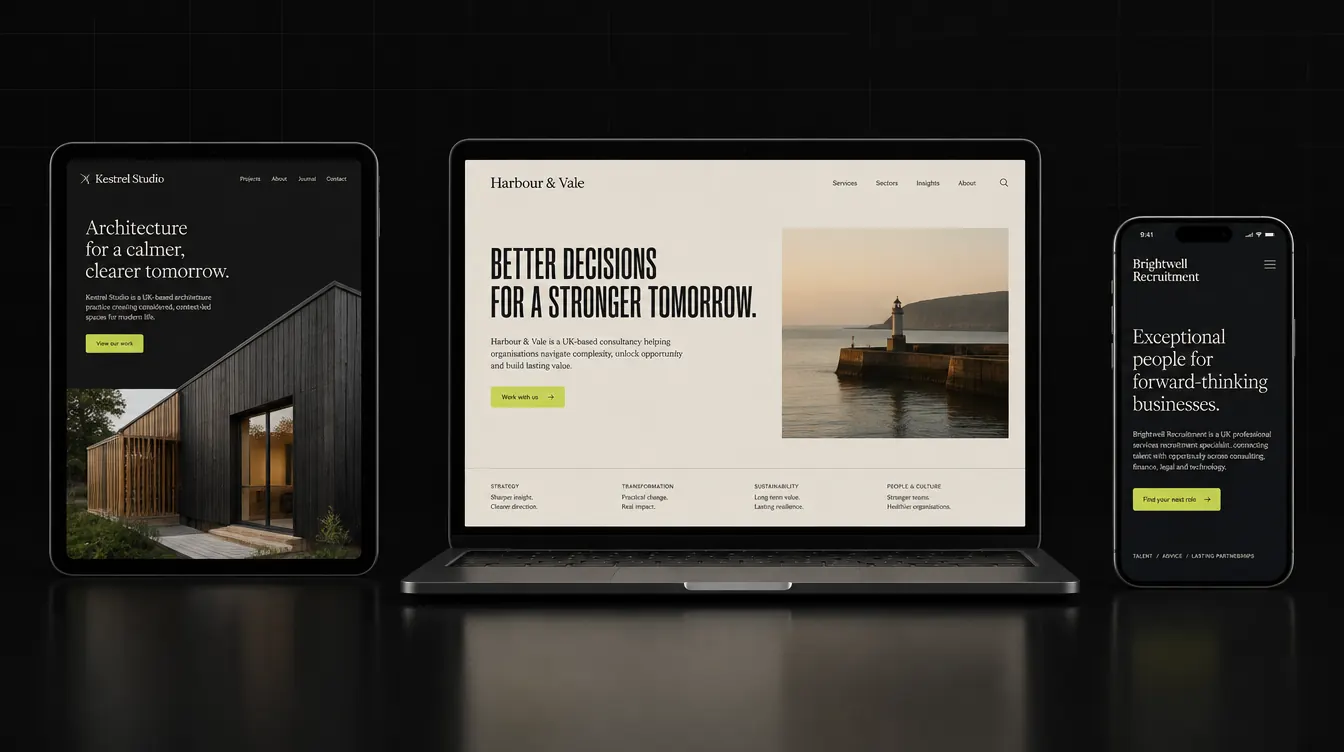
Concept websites for three fictional professional-service firms: Kestrel Studio architecture practice on a tablet, Harbour & Vale consultancy on a laptop and Brightwell Recruitment on a phone
Concept · fictional firmsArchitecture, consultancy and recruitment homepages
5CRISP dimensions scored
60 secFree CRISP score
15 minFree first call
WrittenScope before work starts
[ 01 ]the real problem

You sell judgement. Your website sells adjectives.

Professional-service firms are hired for how they think: the questions they ask, the trade-offs they spot, the work they have already done. Most of their websites say "trusted", "bespoke" and "innovative" instead. A prospective client comparing three shortlisted firms cannot tell them apart, so they fall back on price, gut feel or whoever replied first.

  1. 01Visitors are comparing you against a shortlist, not browsing.
  2. 02They want evidence of similar problems solved.
  3. 03They want to know who would do the work.
  4. 04They need a first step that does not feel like a sales pitch.
[ 02 ]what buyers look for, by sector

What clients check on a professional firm's website.

The buying pattern is similar across sectors: a considered decision, a shortlist and a lot of quiet research before contact. The details differ.

01

Consultancies

Buyers want the problem you solve named in their language, the kind of organisation you usually work with and case studies that explain the situation, not just the logo. Abstract promises about "navigating complexity" rarely survive a shortlist.

02

Architecture practices

Clients look at projects, but they also want the brief, the constraints and how the practice works with planners and budgets. Beautiful images that load slowly on a phone, with no context, only tell half the story.

03

Agencies

Prospective clients expect an agency site to prove the agency's own craft. They look for a clear specialism, work with the problem and approach explained, and signs of who would actually run their account.

04

Recruitment firms

Two audiences arrive at once: hiring managers and candidates. Clients want sector focus, process and how you shortlist. Candidates want live roles. A homepage that serves neither well loses both.

[ 03 ]where professional sites fall short

Common CRISP failures on professional-service sites.

These are the patterns we check across the five CRISP dimensions. The audit shows which apply to your site. See how the CRISP method works or read what a CRISP audit checks.

Contextual: a headline that fits any firm
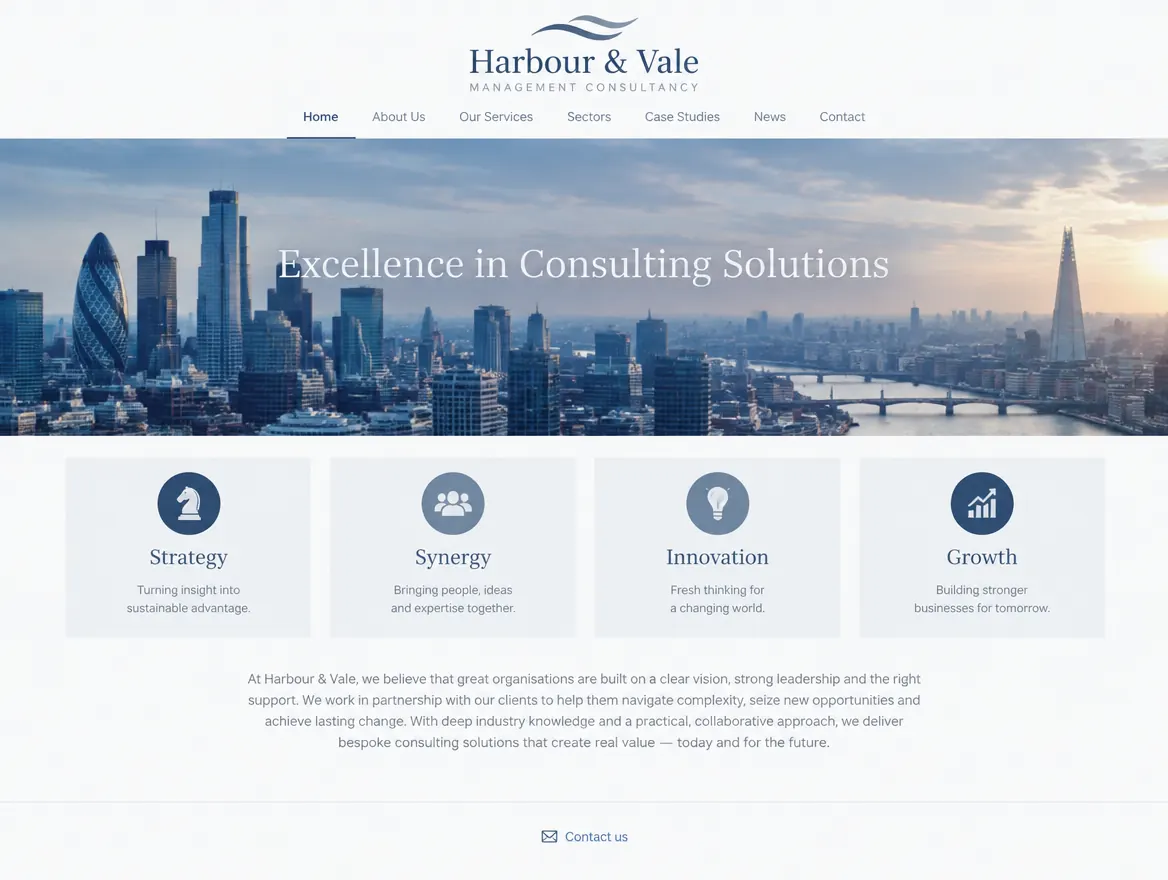
"Excellence in consulting solutions" over a skyline photo. The visitor learns nothing about who you serve, what you do differently or what to do next.
Responsive: heavy portfolios on mobile
Full-size project photography, autoplay video and animation that stutters on a phone. The work may be impressive, but the visitor gives up before it loads.
Intelligent: organised around you, not the buyer
Navigation that mirrors internal departments or service names nobody searches for, with no route by sector, problem or client type.
Seamless: a vague or heavy next step
"Get in touch" with a long form and no idea what happens next, or a recruiter's candidate and client enquiries sent through the same generic form.
Powerful: proof without context
A logo wall with no stories, testimonials without names, case studies that describe deliverables but not the problem or result. Credibility is claimed, not shown.

Legal and financial-advice firms need extra regulatory care with how services, fees and outcomes are described. We can work with them, but your compliance owner approves that wording before launch, and we do not give legal or compliance advice.

[ 04 ]fit and not a fit

Who this works for, and who it doesn't.

Better to say it now. The free audit is useful either way.

A good fit when

  • You are an established UK consultancy, practice, agency or recruitment firm with a team and a track record.
  • Your reputation offline is stronger than your website suggests.
  • Referrals, events, search or paid campaigns already send people to the site.
  • You have rebranded, merged, added a service or entered a new sector and the site has not caught up.
  • A founder, partner or commercial lead can make decisions without a long procurement process.

Not the right fit when

  • You want a template with no changes to content or structure.
  • You need a guarantee of new clients or a set number of briefs.
  • Nobody can supply case study details or confirm client permissions.
  • The main need is a job board platform, CRM or bespoke software.

Accountancy and advisory firms have their own page: see website design for accountants.

[ 05 ]what we do for professional firms

From audit to launch, scoped to the evidence.

Each piece can stand alone. The proposal names the work, review points and exclusions before anything starts.

See how projects are priced →
Free CRISP audit
A score, a grade and three priority fixes for your current site in about 60 seconds. A starting signal, not a full diagnosis. Run the audit.
Website audit and review
A deeper look at your offer, proof, journeys and analytics where available, with priorities you can use yourself or give to your current supplier. See the website audit.
Redesign or rebuild
Structure by sector, problem or audience, case studies rebuilt around the client's situation, team pages, a clearer enquiry path and a responsive build. See website design.
Landing pages
Focused pages for one service, sector or campaign, such as an operations review for manufacturers or a hiring service for a single specialism. See landing pages.
SEO and AI search visibility
Technical foundations, service and sector relevance, structured data and content that answers the questions buyers ask search engines and AI assistants. See SEO.
[ 06 ]how the project runs

Decisions in stages, not one big reveal.

You see the structure before the styling and the styling before the build. Reviews are short and specific, because client work comes first.

  1. 01

    Diagnose

    Run the CRISP audit, then review your offer, audiences, proof, enquiry path, analytics where available and technical constraints.

    Output: evidence, risks and priorities
  2. 02

    Agree

    Confirm the page list, case studies to rebuild, client permissions, integrations, review rounds and exclusions.

    Output: written scope and project plan
  3. 03

    Design and build

    Structure first, then visual design, then the responsive build. You approve each stage before the next starts.

    Output: approved pages and working website
  4. 04

    Verify and launch

    Check forms, redirects, analytics, accessibility, metadata and mobile layouts, then hand over with a note of what was checked.

    Output: checked release and handover
[ 07 ]how the options compare

Three routes to a new firm website.

The real difference is how much diagnosis happens before anything is designed.

What mattersFresh & CrispyTypical agencyDIY / template
Starting pointScored CRISP audit of your current siteBrief and mood boardA theme you pick
PositioningWho you serve and what you solve, in their wordsOften brand language restyledYou write it
Case studiesRebuilt around the client's problem and approachUsually a gallery or logo wallDepends on the template
Regulated sectorsWording flagged and approved by your compliance ownerVariesYour responsibility
Scope and priceAgreed in writing before work startsPackage or estimateSubscription plus your time
GuaranteesNone on results, clear measurement plan insteadSometimes promisedNone

Generalised comparison, not a claim about any named agency.

[ 08 ]concept example

What a CRISP rebuild could look like for a consultancy.

Harbour & Vale is a fictional firm. This is a concept, not client work. Drag the slider to compare.

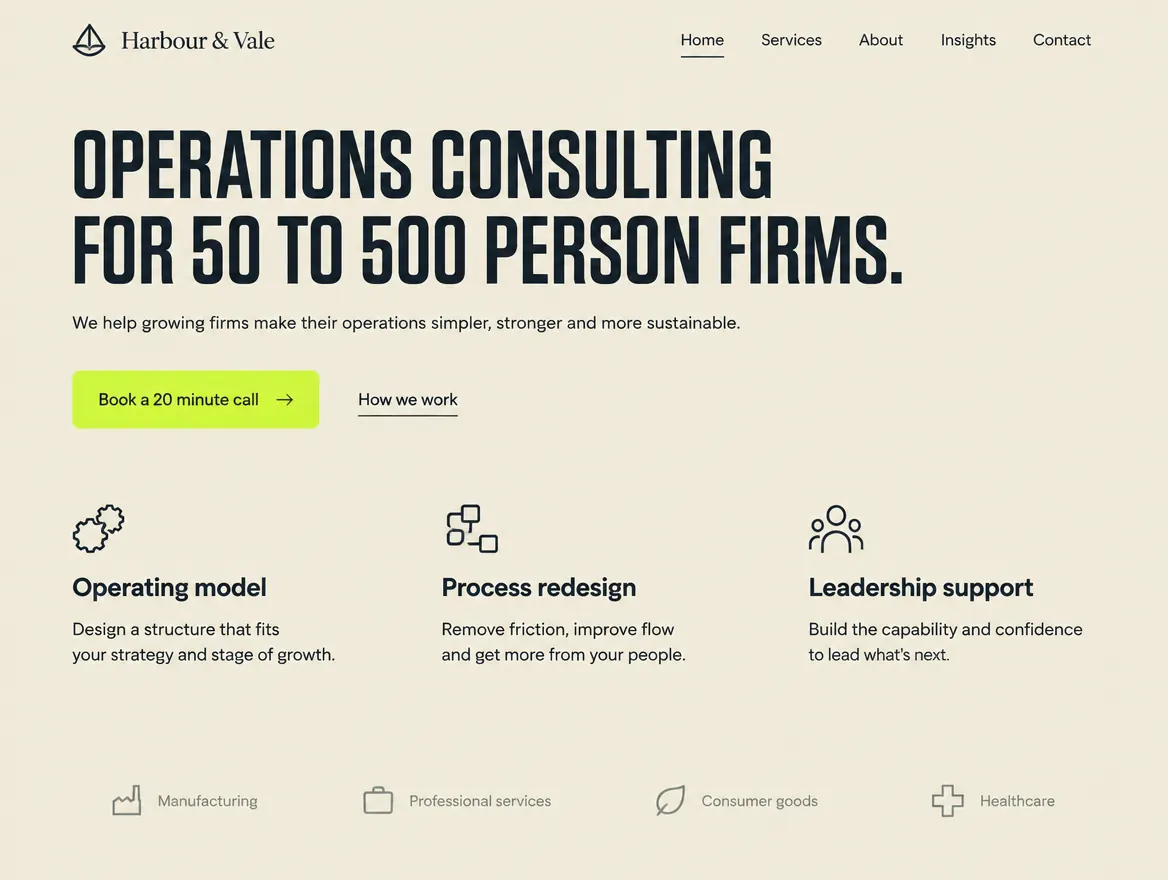
Concept before: a generic management consultancy homepage for the fictional Harbour and Vale, with a city skyline photo, the headline Excellence in Consulting Solutions and four vague icon boxesConcept after: the same fictional Harbour and Vale homepage stating operations consulting for 50 to 500 person firms, with a book a call button and three clear service cardsBeforeAfter
Concept · fictional firmHarbour & Vale, consultancy

What changed, and why

  • A specific promise. "Excellence in consulting solutions" becomes a statement of what the firm does and for what size of business.
  • Services you can recognise. Four abstract values give way to three named services, each saying what it changes.
  • A visible next step. A small "contact us" link at the bottom becomes a clear call button near the top.
  • Sectors as routes. Visitors can find their own industry instead of reading a general paragraph.

On a real site, the next step would be adding proof near the top: permissioned case studies with verified results.

[ 09 ]frequently asked questions

Questions firms ask before they commit.

Straight answers, including the ones that do not flatter us.

How much does professional services website design cost?

There is no package price. A five-person consultancy with three services needs a different scope from an architecture practice with forty projects to migrate or a recruiter with two audiences. Cost follows the unique pages, content and proof work, integrations and migration involved. The proposal states the scope, exclusions and price or pricing basis before you commit.

How long does a project take?

It depends on the page list, content readiness, integrations and how quickly decisions are made. Case studies and team bios are usually the slowest parts, because they depend on people who are busy with client work. We set out stages, review points and assumptions in the proposal rather than promising one timeline for every firm.

Have you worked with firms like ours?

Professional-service firms are who we are set up to serve, but we do not yet have a published case study in these sectors. Our published case study is Vera Music, and its post-launch measurement is still pending. The Harbour & Vale, Kestrel Studio and Brightwell designs on this page are concepts for fictional firms. The free audit is the fairest way to judge our thinking.

Do we need the free CRISP audit first?

No, but it helps when you are not sure what is wrong. It scores your current site across five dimensions in about 60 seconds and returns three priority fixes, which helps decide between a rebuild, a landing page or search work. If you already have a brief, book a 15 minute call and discuss it directly.

Will you guarantee more enquiries?

No. Nobody can honestly guarantee enquiries, briefs or rankings. We show the specific friction we found, explain why it may put a prospective client off and agree how the change will be measured before launch. You get evidence and a measurement plan, not a promise dressed up as a forecast.

We were burnt by our last web agency. Who owns the website?

We put the answers in writing before work starts. The scope covers what is included and excluded, who reviews what, and the ownership, access and hosting arrangements at handover. If your current supplier is doing good work on part of the site, we will say so and scope around it rather than replacing everything by default.

Do you work with law firms or financial advisers?

We can, with extra care. Legal and financial-advice firms have regulatory rules about how services, fees and outcomes are described, and we do not give legal or compliance advice. We write clear copy, flag anything that may need checking and ask your compliance lead to approve it before launch. Some projects will need longer review for that reason.

What do you need from us, and what happens after launch?

We need one decision owner, access to the current site and analytics where available, and someone who can supply or approve case study details and client permissions. After launch you get a handover that states what was checked. Ongoing SEO, new landing pages or conversion work are scoped separately if the evidence supports them.

[ 10 ]see where your site stands

See what your shortlist sees before they decide.

Run the free CRISP audit for a score and three priority fixes, or book a short call and we will look at your site with you.

Not ready yet? Read whether testimonials increase conversions, or browse all industries.