
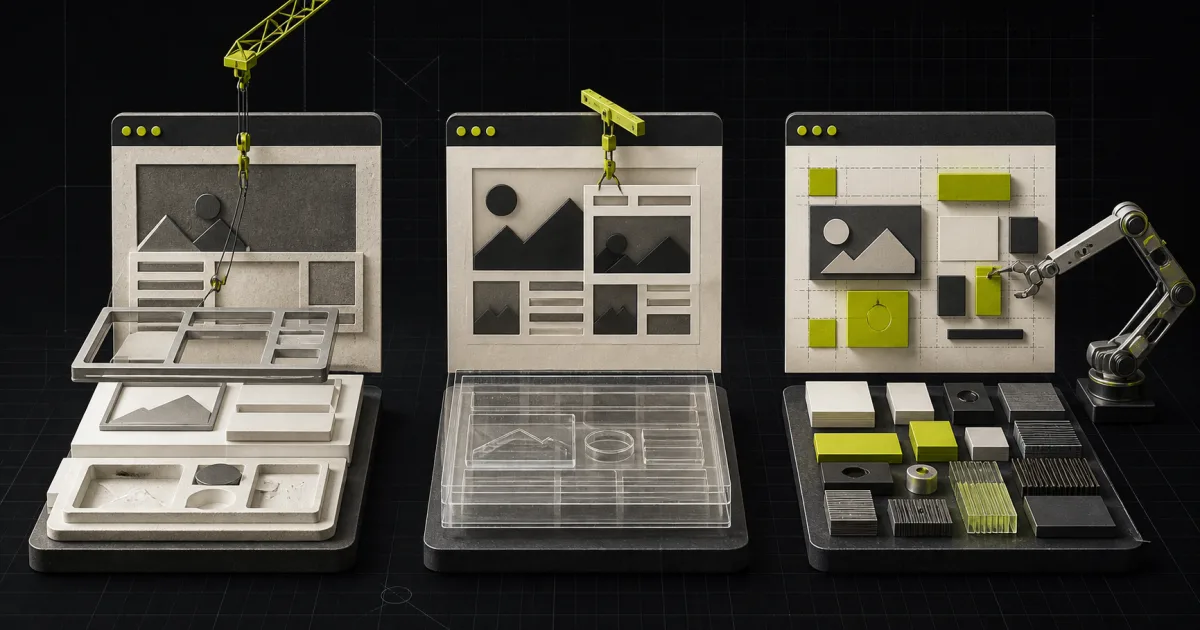
What do Wix, Squarespace, and "custom" actually mean?
The Wix vs Squarespace vs custom website decision gets argued badly on the internet, usually by people selling one of the three. So let us define terms before comparing anything. Wix and Squarespace are hosted website builders: you pay a subscription, pick a template, and assemble pages in a visual editor. The software, hosting, and security are handled for you, and the site lives on the platform's infrastructure for as long as you keep paying.
A custom website means code written or assembled for your business specifically, hosted where you choose, owned by you. It does not necessarily mean expensive, and it does not mean every line is bespoke: a custom build might use an established framework or CMS underneath. The defining features are control and ownership, not artisanal purity. A freelancer's £1,500 build on standard tooling and a studio's £6,000 design-led build are both "custom" in the sense that matters here.
All three are legitimate products. The honest question is not which is best, it is which fits the job your website has to do, at the stage your business is actually at. That answer changes over time, which is why this comparison spends as much time on the ceiling as on the floor.
When a DIY website builder is genuinely the right call
Some comparisons of builders and custom sites are written as a slow insult to builders. This one will not be, because for a real slice of UK small businesses the builder is simply the correct purchase.
You are early and cash is tight. A new business does not know its message, its customers, or sometimes its own name yet. Spending thousands on a custom site before the business has settled is how people end up rebuilding twice. £200 a year while you find out what the business is: sensible.
The site's job is presence, not performance. If most work arrives by referral and the website exists so people can check you are real, find your number, and see a few photos, a well-filled template does that job completely. Paying for custom design to serve that brief is buying capability you will not use.
Your needs are genuinely simple. A handful of pages, a contact form, maybe a gallery or a booking embed. Builders handle this well, and both Wix and Squarespace ship templates that look clean out of the box, Squarespace especially so.
You need it live this week. No supplier route gets a presentable site up faster than an evening with a template. Speed to live is a real business advantage that comparisons pretending builders have no virtues always skip.
If that describes you, take the builder route without guilt, spend the savings on photography and decent copy, and revisit the decision when the website acquires a measurable job. What that revisit looks like is covered in the signs your website needs a redesign.
Where the ceiling appears: builder limits that actually matter
The limits below are not hypothetical, they are the specific points where we see businesses outgrow their builder. None of them matters until it does; all of them are real when they arrive.
Performance under the template
Builder templates carry the code for everything the template can do, not just what your site uses, and you cannot strip what you do not need. Both platforms have improved genuinely in recent years, and a light template with optimised images can score respectably. But when a builder site fails Google's Core Web Vitals thresholds, your levers are limited to removing content and compressing images. On a custom site, the build itself is the lever: what loads, when, and in what order is a decision someone made and can change.
SEO control
Let us be fair first: builders cover the basics well. Editable titles and meta descriptions, generated sitemaps, redirects, mobile-friendly output, HTTPS. Everything in Google's SEO starter guide is achievable on either platform, and builder sites rank perfectly well for local and lower-competition terms. The ceiling is in the fine control: granular structured data beyond what the platform generates, precise internal linking at scale, URL architecture decisions, and the page-speed work above. In competitive markets those margins are often where the ranking difference lives.
Design differentiation
A template used by thousands of businesses can be customised in colour, type, and imagery, but its bones show. Section rhythms, layout patterns, and spacing are recognisable, and within a local market it is common for two competitors to be visibly wearing the same theme. Whether that matters depends on your market: for a village plumber, not much; for a firm selling design-adjacent credibility, quite a lot. Differentiation is one of the main things a custom design is actually buying.
Conversion optimisation constraints
Serious conversion work is iterative: form variants, layout experiments, measurement wired to every enquiry route. Builders permit the basics (editing pages, adding analytics) but constrain the deeper moves: custom form logic, fine-grained event tracking, structural page experiments. You can improve a builder site's conversion; you run out of adjustable parts sooner.
Export and lock-in
This is the least advertised limit. Your domain is yours and moves freely. Your content is copyable. But neither platform gives you the site: Wix offers no full export, and Squarespace's export covers only some content types in a generic format. The design, structure, and everything you built in the editor stay behind. Leaving a builder always means rebuilding, which is manageable when planned and painful when discovered late.
What a custom website actually means (and what it does not)
"Custom" has been marketed into meaninglessness, so here is the practical definition. A custom website is one where someone made deliberate decisions about your specific business at every layer: what the pages say, how they are structured, what loads and why, how enquiries are captured and measured. It is hosted in an account you control, under a domain you own, in code you can take to any competent developer on the planet.
What custom does not mean: reinventing everything from zero, or a six-figure invoice. Plenty of excellent custom sites are modest, fast, hand-built brochure sites with ten pages and no framework ceremony at all. The point is not the exotic technology, it is that nothing on the site is there because a template shipped it, and nothing is missing because a platform disallowed it.
What custom costs: across the UK market, roughly £500 to £2,500 from a freelancer and £2,000 to £7,500 from a small studio, with agencies above that. The full breakdown, including the three-year cost of ownership where builders and custom get closer than the sticker prices suggest, is in our guide to small business website costs in the UK.
Wix vs Squarespace vs custom: the comparison table
Every row here is a generalisation with exceptions, but as a decision aid it is honest:
| Factor | Wix | Squarespace | Custom build |
|---|---|---|---|
| Upfront cost | None (your time) | None (your time) | £500 to £7,500+ (UK market) |
| Running cost | ~£100 to £400/yr | ~£150 to £400/yr | Hosting + domain, ~£100 to £400/yr |
| Time to live | Days | Days | Weeks |
| Design ceiling | Flexible but template-bound | Polished but template-bound | Whatever you decide |
| Speed control | Limited to content choices | Limited to content choices | Full, decided in the build |
| SEO control | Good basics, partial fine control | Good basics, partial fine control | Full, including structured data |
| Conversion testing | Basic | Basic | As deep as you want to go |
| Scalability | Good until requirements get specific | Good until requirements get specific | Grows by decision, not permission |
| Ownership | Domain and content only | Domain and content, partial export | Everything, portable anywhere |
| Maintenance burden | Platform handles it | Platform handles it | Yours or your supplier's |
| Best for | Early stage, app-led needs | Early stage, design-led presence | Sites with a measurable job |
Notice the maintenance row, because it is the builders' quietest advantage: on Wix or Squarespace, security patches and software updates are simply not your problem. A custom site needs someone responsible for it, whether that is a maintenance plan or an arrangement with your builder. If nobody will own that, the builder column deserves more weight than this article's readership probably wants to give it.
Outgrowing a builder: how to migrate without losing what you built
When a builder site has done its job and the ceiling is now costing you, the move to a custom build needs more care than enthusiasm. Four things decide whether a migration goes cleanly.
Content comes out by hand or by export, so audit it first. Copy every page, image, and blog post into a structured document before anyone touches anything. Squarespace's export helps partially; on Wix, assume manual. This is also the moment to cut the pages that never earned their keep, because migrating dead weight costs the same as migrating value.
URLs must be mapped, every one. Each old URL needs either a matching new URL or a 301 redirect to its closest equivalent. Skipping this is the single most common way businesses hurt their own search visibility during a move. Any competent supplier will produce a redirect map as a standard deliverable; treat its absence as a warning.
The domain and analytics move with you. Because the domain was always yours, pointing it at the new site is straightforward. Keep the same analytics property so history stays continuous, and confirm Search Console access before and after so you can watch for crawl errors in the weeks that follow.
Time the switch, keep the old site paid up. Run the platform subscription for a month or two past launch. It is a cheap insurance policy against discovering a page or image nobody copied.
Handled this way, a builder-to-custom move is routine, and it is a large part of what a structured website rebuild is: not just new design, but the unglamorous mapping and redirecting that protects what the old site earned.
How to decide: match the route to the site's job
Strip away the platform arguments and the decision reduces to three questions.
What is the website's job? If the job is "exist credibly", a builder does it. If the job is "produce enquiries we can count and grow", the control a custom build offers starts paying rent: speed you can tune, pages designed around the enquiry, measurement wired through everything.
What does failure cost? A portfolio site that underperforms costs pride. A site that is the front door for £200,000 of annual enquiries and converts at half its potential costs real money silently, every month. The more the site carries, the more the case for control strengthens.
Who will do the work? A builder with an engaged owner beats a custom site nobody maintains. Be honest about the time and attention each route gets after launch, not just at purchase.
And if you are mid-decision with a live site today, get evidence before ideology: run the free audit on the current site. If it scores well, the platform is not your problem and you just saved a rebuild budget. If it scores badly in ways the template will not let you fix, you have your answer, in writing, with specifics.
Frequently asked questions
Is Wix or Squarespace better for a small business?
They are closer than the arguments about them suggest. Squarespace tends to suit design-led businesses that want polished templates with fewer decisions; Wix offers more apps and layout freedom at the cost of more ways to make a mess. For a simple brochure site, either can do the job well. The bigger decision is builder versus custom, which depends on how much work the site has to do.
Can a Wix or Squarespace site rank well on Google?
Yes. Both platforms cover the essentials Google's own documentation asks for: crawlable pages, editable titles and descriptions, sitemaps, redirects, and mobile-friendly templates. Plenty of builder sites rank well for local and low-competition terms. The limits appear in competitive markets, where fine control over page speed, structured data, and site architecture becomes an advantage that builders only partly allow.
How much more does a custom website cost than a builder?
A builder costs £100 to £400 a year plus your time. Across the UK market, a custom site built by a freelancer typically runs £500 to £2,500, and £2,000 to £7,500 through a small studio. Over three years the gap narrows once you price your own hours and subscription costs, but custom remains the larger investment. It is justified when the site is a primary source of enquiries.
Can I move my website off Wix or Squarespace later?
Partially. You keep your domain and can point it anywhere, and your text and images can be copied out. Squarespace offers a limited export that covers some content; Wix has no full site export. The design and page structure do not transfer either way, so a move means a rebuild. That is normal and manageable, but budget for it as a rebuild, not a transfer.
When should I switch from a website builder to a custom site?
Switch when the site has a measurable job it is visibly failing at: enquiries flat while traffic grows, speed scores you cannot improve from inside the template, a design you cannot make distinct from competitors on the same theme, or integrations the platform will not support. If the builder site is doing its job, keep it. The right trigger is evidence, not embarrassment.