
What is a landing page?
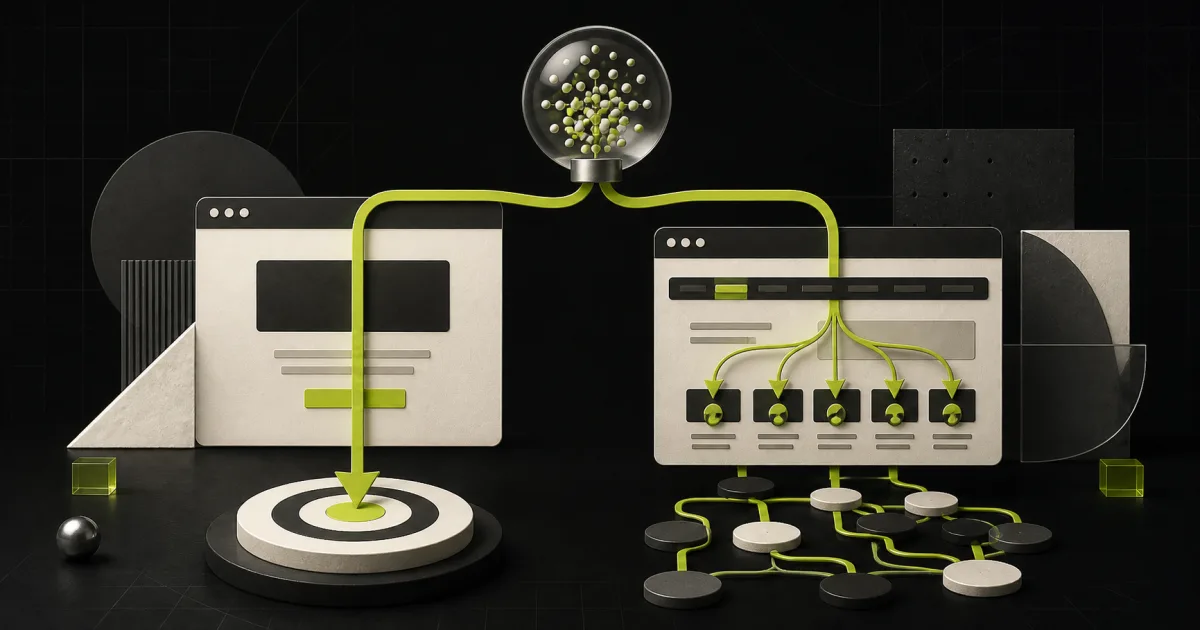
In the landing page vs homepage debate, the terms need pinning down first, because "landing page" gets used loosely. Strictly, a landing page is any page a visitor lands on. In marketing practice, and in this article, it means something narrower: a standalone page built for one campaign and one audience, making one offer, asking for one action. No competing messages, minimal navigation, nothing that serves anyone except the visitor the campaign targets.
A good landing page reads like a continuation of the ad that was just clicked. Same promise, same language, same offer, now with the detail, the proof, and the form. That continuity is the entire point of building one.
What is a homepage for?
A homepage is the front door to everything. It has to serve the customer ready to buy, the researcher comparing options, the past client looking for your number, the potential hire, and the supplier, all in the same screenful. Nielsen Norman Group's homepage usability guidelines run to over a hundred points precisely because the homepage carries more simultaneous jobs than any other page on a site.
None of that makes homepages bad. A clear homepage is one of the hardest and most valuable pages to get right. It makes them generalists, and generalists lose to specialists when the visitor arrives with one specific promise ringing in their ears.
Why ad traffic sent to a homepage usually underperforms
Three forces work against the homepage as an ad destination, and they compound.
Message match breaks. Someone clicks an ad for "fixed-price kitchen refits in Leeds" and arrives at a page whose headline talks about craftsmanship since 1987. The promise they clicked has vanished, and the visitor has to work out whether they are even in the right place. Most will not bother; the back button is closer. Google's own guidance on landing page experience makes the same point from the other direction: relevance between ad and destination is part of how ads are assessed, so a mismatched destination can cost you twice, once in lost visitors and again in how your ads compete.
One page cannot have one job for everyone. The homepage must hedge. It introduces four services, links to the blog, mentions the team, and invites three different actions, because it has to. A campaign page has no such excuse: the visitor's intent is known, because you wrote the ad that filtered them. Giving that visitor a hedged, general page throws away the targeting you just paid for.
Too many exits. Every navigation item, footer link, and secondary banner on a homepage is a legitimate path for an organic visitor and a leak for a paid one. Each click that wanders off to the blog or the about page is money spent on a visit that ends somewhere other than an enquiry. On a dedicated page, the exits are cut down to the one action that justifies the ad spend, a principle we unpack in how many CTAs a page should have.
When the homepage is the right ad destination
The homepage earns the click in a few specific situations. Brand-name searches are the clearest: someone typing your business name into Google wants the front door, and routing them to a narrow campaign page would feel evasive. Broad brand awareness campaigns, where the ad promises nothing more specific than the business itself, match the homepage's general remit. And for a very small budget testing whether ads produce anything at all, a strong homepage can be an acceptable first destination while you learn, provided you treat its results as a floor rather than a verdict.
There is one more honest case: when your homepage is simply better than anything else you could build quickly. A sharp, fast homepage with a clear offer will beat a rushed, thin landing page. The comparison is between real pages, not ideal ones.
What a dedicated landing page needs to earn its keep
A landing page is not a stripped-down homepage. It is built from the ad backwards, and it needs six things.
A headline that repeats the promise. The visitor should see the words they clicked, or their obvious twin, within the first second. One action, asked for clearly and repeated down the page: a quote request, a booked call, a form. Proof next to the ask: a named testimonial, a specific result, a recognisable client, placed where the decision happens rather than on a separate page. Answers to the obvious objections: price ballpark, timescale, what happens after the form. Speed, because paid visitors are the most expensive ones you can lose to a slow load. And a form that asks for less than feels natural: name, contact, message, with qualifying questions saved for the reply.
Skip the temptation to bolt on extras. Every element either supports the one action or competes with it, and competition is what the page was built to remove. If several of these ingredients sound like the reasons pages fail generally, that is no coincidence: the same failures we catalogue in why websites do not convert apply with interest when every visitor costs money.
Landing page vs homepage: the comparison at a glance
| Dedicated landing page | Homepage | |
|---|---|---|
| Audience | One segment, defined by the campaign | Everyone who finds the business |
| Message | Repeats the ad's exact promise | Introduces the whole business |
| Actions asked for | One, repeated | Several, competing |
| Navigation | Minimal or none | Full site navigation |
| Exits available | Deliberately few | Many, all legitimate |
| Best traffic fit | Paid ads, promotions, specific offers | Brand searches, direct visits, referrals |
| Measure of success | Conversion on one action | Routing visitors to the right place |
How to decide for your next campaign
Read the ad you are about to run and ask one question: what exact promise does this make? If the answer is a specific service, offer, price, or outcome, build or reuse a page whose headline repeats that promise, and send the traffic there. If the answer is "the business itself", the homepage is the destination. That single test settles most cases without further debate.
Then hold the destination to account. Track the one action the page exists for, compare cost per enquiry across destinations, and let the numbers argue. Businesses are often surprised by how large the gap is; the difference between a matched page and a general one is frequently the difference between a campaign that pays and one that quietly burns budget. If you want pages built this way, that is exactly what our landing pages service does, and if you are not sure whether your current destination is the leak, the free audit will score it in about a minute.
Do not judge the choice on conversion rate alone. A narrow page can produce more form submissions while attracting weaker enquiries, especially if its promise is broader than the service behind it. Track qualified enquiries and eventual customers as well as clicks and forms. The better destination is the one that creates the right conversations at a sustainable cost, not merely the largest number in an analytics report.
Record the campaign and page version too, so later comparisons use the same audience and offer.
Frequently asked questions
Can I use my homepage as a landing page for ads?
You can, and for brand-name searches it is usually the right choice, because those visitors want the front door. For any ad promising a specific service, offer, or outcome, a homepage tends to underperform, because it cannot repeat the promise the visitor just clicked, and it offers a dozen exits before the one action you paid for. Match the destination to the promise in the ad.
Does a landing page need to be on my main website?
It works either way, but keeping landing pages on your main domain is usually simpler and more trustworthy. Visitors see a web address that matches the business they clicked on, your analytics stay in one place, and the page benefits from any recognition your domain has earned. Separate landing page tools are fine too, provided tracking is wired up and the design does not feel like a different company.
How many landing pages do I need for my ad campaigns?
One per distinct promise, not one per keyword. If you run ads for boiler repairs and bathroom fitting, those are two promises and two pages. Ten keyword variations about boiler repair can share one page, because the visitor's intent is the same. Start with a page for each service you advertise, watch which converts, and only split further when the data shows a mismatch.
Should a landing page have normal site navigation?
The standard practice for paid campaign pages is to reduce or remove the main navigation, because every menu item is an exit that competes with the action you paid for. Keep the logo, a phone number, and the legal links. For landing pages that also earn organic search traffic, full navigation makes more sense, since those visitors arrive at various stages and may genuinely need other pages.