
What is conversion rate optimisation, in plain English
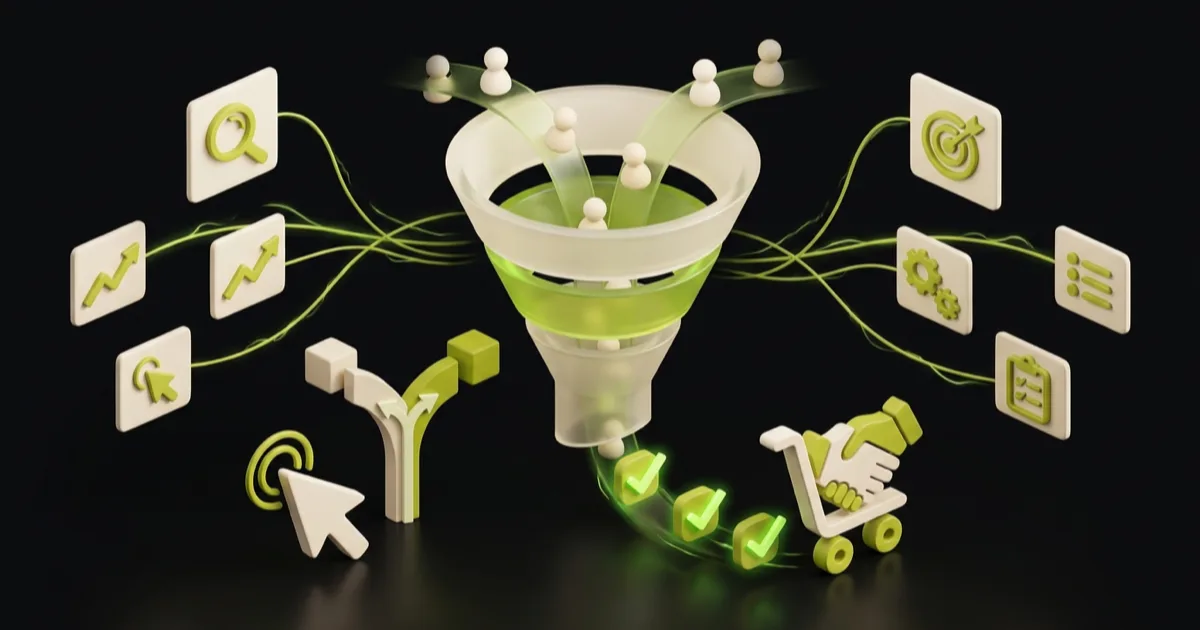
Your conversion rate is the percentage of website visitors who do the thing you want them to do: submit an enquiry form, book a call, ring the number, or buy. If 1,000 people visit your site in a month and 20 of them enquire, your conversion rate is 2%. Conversion rate optimisation is the deliberate process of raising that percentage, not by finding more visitors, but by removing whatever is stopping the visitors you already have.
That distinction matters because it's the opposite instinct to most marketing spend. SEO, ads, and social media all try to get more people to your site. CRO asks a different question: of the people already arriving, why aren't more of them converting, and what specifically is in their way? A 1% improvement in conversion rate on a site that already gets a fixed amount of traffic is, in practical terms, the same as finding 1% more traffic, except it usually costs less and compounds every month afterwards.
CRO isn't a single trick, a button colour, or a piece of software. It's a discipline applied to a website: look at real behaviour, form a specific theory about what's blocking conversions, change the page to test that theory, and measure the result. Nielsen Norman Group's research on how conversion rate is defined and tracked makes the same point: the number itself is less useful than what moves it, which is why CRO treats conversion rate as a diagnostic, not a vanity metric.
How CRO actually works: audit, hypothesis, test, measure
Every proper CRO process follows the same four-stage loop, whether it's run by an agency or a business owner with an afternoon free.
Audit. Look at where visitors actually go and where they stop. This can be as simple as walking through your own site's enquiry journey on a phone, or as detailed as reviewing analytics, session recordings, and heatmaps. The goal is to find the specific point where people who intended to convert didn't.
Hypothesis. Turn the observation into a testable statement: "visitors are leaving the pricing page because there's no clear next step" is a hypothesis. "The site needs to be more modern" is not, because it can't be proven right or wrong. A good hypothesis names a specific problem and a specific expected effect if it's fixed.
Test. Make the change. On a low-traffic small business site, this is usually a direct change followed by before-and-after comparison, because there isn't enough traffic for a statistically reliable split test in a reasonable time. On a higher-traffic site, an A/B test that splits visitors between two versions gives a cleaner result. CXL's guide to conversion rate optimisation sets out this research-then-test methodology in more depth, including how to decide which method fits your traffic volume.
Measure. Check whether the conversion rate actually moved, over enough time and enough visitors to trust the result, not just the first encouraging day. If it didn't move, that's a valid outcome too: it rules out a theory and points the next hypothesis somewhere else. CRO is iterative by design. One fix rarely finishes the job, but each cycle should leave the site slightly better than it found it.
A worked example makes this concrete. Say a tradesperson's site gets a steady trickle of visitors from Google but very few enquiries. The audit shows most visitors land on the homepage, scroll past the services list, and leave without reaching the contact form, which sits at the very bottom of the page. The hypothesis: moving a simple call-to-action button higher up, near the services list, will catch visitors before they lose interest. The test: add that button and leave everything else unchanged. The measurement: compare the enquiry count over the following weeks against the same period before the change, accounting for any change in traffic volume. If enquiries rise while traffic stays flat, the hypothesis holds and the change stays. If nothing moves, the real blocker is elsewhere, and the next hypothesis targets something else, perhaps the clarity of the services list itself rather than its distance from the fold.
What a good conversion rate looks like
There's no single universal target, because conversion rate depends heavily on industry, traffic source, and how "conversion" is defined on your particular site. A paid ad landing page for an emergency service will convert differently to a blog post for a considered B2B purchase, and a visitor who searched your exact business name is a different prospect to one who clicked a broad, unbranded search term. What matters more than chasing an industry average is knowing your own baseline and moving it, since almost every small business site we've audited has room to improve regardless of where it currently sits.
It also matters what you count as a conversion in the first place. A form submission, a phone call click, and a newsletter signup are not the same event, and blending them into one number can flatter or understate the picture depending on which one dominates. Decide what actually counts as a genuine enquiry for your business, measure that specifically, and treat everything else as a secondary signal rather than the headline figure.
We've written a fuller breakdown of realistic benchmarks and how to read your own number in what counts as a good website conversion rate, including how to account for traffic quality before comparing yourself to anyone else's figures.
Common reasons visitors don't convert
Most conversion problems fall into a short list of repeatable causes. Before running any test, it's worth checking your own site against each of these, because the fix is often faster than the audit that finds it.
| What you see | Likely cause | What to check |
|---|---|---|
| High traffic, few enquiries | The page doesn't match what the visitor was searching for or clicked on | Compare your headline against the exact search term or ad that brought them |
| Visitors read but don't act | No single, obvious next step on the page | One clear primary call to action, visible without scrolling |
| Forms started, rarely finished | Too many fields asked too early | Cut the first form to name, contact detail, and message; ask the rest later |
| Fast bounce, seconds only | Visitors can't tell what you do or who it's for | Run the five-second test: can a stranger say what, who, and next? |
| Mobile bounce much higher than desktop | The mobile journey is slow or fiddly to complete | Complete an enquiry yourself, on your own phone, start to finish |
We go through the full list of drop-off causes in more detail in why visitors leave a website without enquiring and what to check when your website isn't converting, both of which expand on the diagnostic side of this table.
Do testimonials and CTAs actually affect conversion?
Yes, and predictably so, though not because of any single magic element. Trust signals and calls to action work because they remove two different kinds of hesitation. Testimonials answer the unspoken question "can I trust this business", especially when they're specific and attributed to a real name rather than an anonymous quote floating on a page. Calls to action answer a different question: "what do I do now", and a page without an obvious answer to that question loses visitors who were otherwise ready to act.
Both of these are easy to get wrong in opposite directions: too few CTAs and visitors don't know what to do; too many, competing CTAs and visitors don't know which one matters. We've covered the evidence and the practical rules for both separately in whether testimonials increase conversions and how many calls to action a page should actually have. Baymard Institute's usability research on checkout and conversion flows reaches a similar conclusion from large-scale testing: clarity and reduced friction consistently beat persuasive decoration.
When to hire a CRO agency vs DIY
A lot of CRO is genuinely doable yourself, especially the first pass. Walking your own enquiry journey on your phone, checking your forms for unnecessary fields, and making sure every page has one clear next step are all things a business owner can do in an afternoon, without any specialist tool or budget. If your site is small and your traffic is modest, start there before spending anything.
Where it's worth bringing someone in is when the obvious fixes have already been made and the problem is less visible: a mismatch between what your ads promise and what your landing page delivers, a trust gap you can't see because you know the business too well to notice its absence, or a technical issue quietly breaking the mobile journey for a subset of visitors. An outside conversion optimisation service brings a structured audit process and enough pattern recognition across other sites to spot problems a business owner, too close to their own site, tends to miss. It's also the more efficient route if you're launching a new landing page and want it built to convert from day one, rather than fixed after months of underperformance.
There's also a traffic threshold worth being honest about. Formal split testing needs enough visitors reaching the page in question to produce a result you can trust rather than noise; a page that gets a handful of visits a day will take months to reach that point through testing alone. Below that threshold, the more useful approach is a heuristic audit against known usability patterns, followed by direct, confident changes and a before-and-after comparison, rather than waiting for a test that will never gather enough data. Knowing which situation you're in is itself part of what a good CRO process should tell you early, before any time gets spent on the wrong method.
Either way, the starting point is the same: know your current number before changing anything, and run a proper free website audit to see where visitors are actually dropping off rather than guessing.
Frequently asked questions
What is conversion rate optimisation?
Conversion rate optimisation (CRO) is the practice of increasing the percentage of website visitors who complete a wanted action, such as an enquiry, booking, or purchase, without spending more on traffic. It works by finding where visitors hesitate or leave, forming a specific hypothesis about why, changing the page, and measuring whether more visitors convert.
What's a good conversion rate for a small business website?
For most UK service businesses, a conversion rate from 2% to 5% of visitors completing an enquiry is a reasonable working range, though it varies by industry, traffic source, and how the rate is measured. What matters more than hitting a benchmark is knowing your own current rate and moving it upward, since a low rate today just means there is room to improve.
How much does CRO cost?
A single, focused round of CRO work, covering an audit and a set of prioritised fixes, is typically a few hundred to a few thousand pounds for a small business site, depending on scope. Ongoing structured testing programmes cost more because they need enough traffic and time to reach reliable results. Most small sites are better served by an audit-led fix than an open-ended testing programme.
How is CRO different from SEO?
SEO gets more of the right people to your website. CRO makes sure more of the people who arrive actually enquire once they're there. They are complementary, not competing: a site that ranks well but converts poorly is wasting the traffic SEO earns it, and a site that converts brilliantly but nobody finds has nothing to convert.